
Professor,
Group Coordinator
Biography
Dr. Phanish Suryanarayana is a Professor in the School of Civil and Environmental Engineering and holds an adjunct position in the School of Computational Science and Engineering. He received his B.Tech. in Naval Architecture and Ocean Engineering from Indian Institute of Technology Madras, India in 2005. He received his M.S. and Ph.D. in Aeronautics from California Institute of Technology in 2006 and 2011, respectively. Dr. Suryanarayana started at Georgia Tech in August 2011, earned tenure and promotion to Associate Professor in August 2017, and promotion to full Professor in August 2023. He was also the Clifford and William Greene, Jr. Early-Career Professor from July 2021 to June 2024.
Research
Dr. Suryanarayana has established a research program at Georgia Tech in the area of multiscale modeling of materials/structures, with particular emphasis on ab initio methods. Specifically, he is interested in developing mathematical/computational tools that enable the characterization of materials/structures at different length/temporal scales as well as the transition between them. Overall, his goal is to design new materials/structures with unique/extraordinary properties tailored to technological applications.
Teaching
Dr. Suryanarayana teaches several undergraduate and graduate level courses. He created the graduate courses on Computational Methods in Mechanics and Advanced Solid Mechanics. The long term educational goal of Dr. Suryanarayana is to instill his passion for science and engineering into students, and equip them with the necessary knowledge and skills to pursue successful careers, particularly in STEM related fields.
Distinctions & Awards
-
CEE Interdisciplinary Research Award 2019
-
CEE Excellence in Research Program Development Award 2018
-
NSF CAREER Award 2016
-
CEE Bill Schutz Junior Faculty Teaching Award 2015
-
Robert J. Melosh Medal 2010
-
Rolf D. Buhler Memorial Award in Aeronautics 2006
Publications
-
Bhowmik, S., Medford, A.J., Suryanarayana, P., Sharma, A. and Pask, J.E., 2025. Ab initio study of strain-driven vacancy clustering in aluminum. Physical Review B, 112(17), p.174105.
-
Kumar, S., Zhang, Z. and Suryanarayana, P., 2025. Ab initio study of flexoelectricity in MXene monolayers. Nanotechnology, 36(36), p.365701.
-
Thapa, B., Oellerich, T.G., Emelianenko, M., Suryanarayana, P. and Mazin, I.I., 2025. Orbital-free density functionals based on real and reciprocal space separation. npj Computational Materials, 11(1), p.149.
-
Jing, X., Sharma, A., Pask, J.E. and Suryanarayana, P., 2025. GPU acceleration of hybrid functional calculations in the SPARC electronic structure code. The Journal of Chemical Physics, 162(18).
-
Zhang, B., Shah, S., Pask, J.E., Chow, E. and Suryanarayana, P., 2025. Random Phase Approximation Correlation Energy Using Real-Space Density Functional Perturbation Theory. Journal of Chemical Theory and Computation, 2025, 21, 12, 6023–6033.
-
Bhowmik, S., Pask, J.E., Medford, A.J. and Suryanarayana, P., 2025. Spectral scheme for atomic structure calculations in density functional theory. Computer Physics Communications, 308, p.109448.
-
Suryanarayana, P., Bhardwaj, A., Jing, X., Kumar, S. and Pask, J.E., 2025. Accuracy of Kohn–Sham density functional theory for warm-and hot-dense matter equation of state. Physics of Plasmas, 32(3).
-
Sharma, A., Kumar, S. and Suryanarayana, P., 2025. Cyclic and helical symmetry-informed machine learned force fields: Application to lattice vibrations in carbon nanotubes. Journal of the Mechanics and Physics of Solids, 194, p.105927.
-
Shah, S., Zhang, B., Huang, H., Pask, J.E., Suryanarayana, P. and Chow, E., 2024, November. Many-body electronic correlation energy using krylov subspace linear solvers. In SC24: International Conference for High Performance Computing, Networking, Storage and Analysis (pp. 1-15). IEEE.
-
Jing, X. and Suryanarayana, P., 2024. Efficient real space formalism for hybrid density functionals. The Journal of Chemical Physics, 161(8).
In the News
Awards honor leadership, teaching excellence, impactful research for 2018
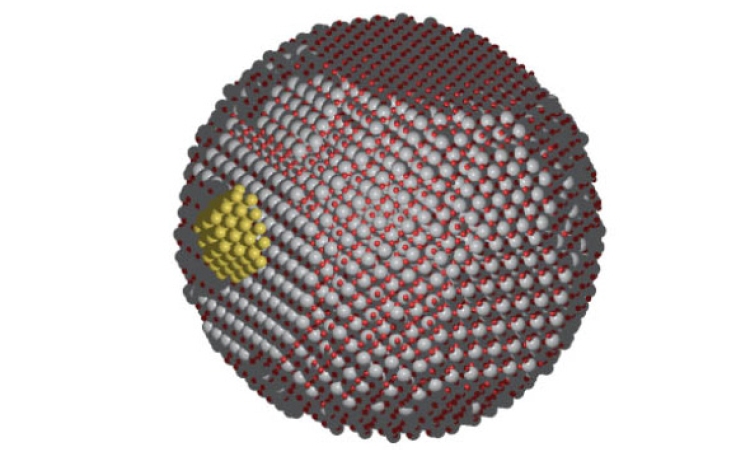
Suryanarayana leads new $3M project to unlock the power of tomorrow’s supercomputers for understanding chemical phenomena