
Google Scholar
Yang Wang
Professor
Biography
Dr. Yang Wang is a Professor in Civil and Environmental Engineering at the Georgia Institute of Technology, where he also holds an adjunct position in Electrical and Computer Engineering. His research interests include structural health monitoring, system identification, model updating, and wireless and mobile sensors. Dr. Wang received an NSF Early Faculty Career Development (CAREER) Award in 2012 and a Young Investigator Award from the Air Force Office of Scientific Research (AFOSR) in 2013. In 2017, he received the Achenbach Medal from the international research community in structural health monitoring. Dr. Wang currently serves as an Associate Editor for Structural Health Monitoring – an International Journal (SHMIJ).
Research
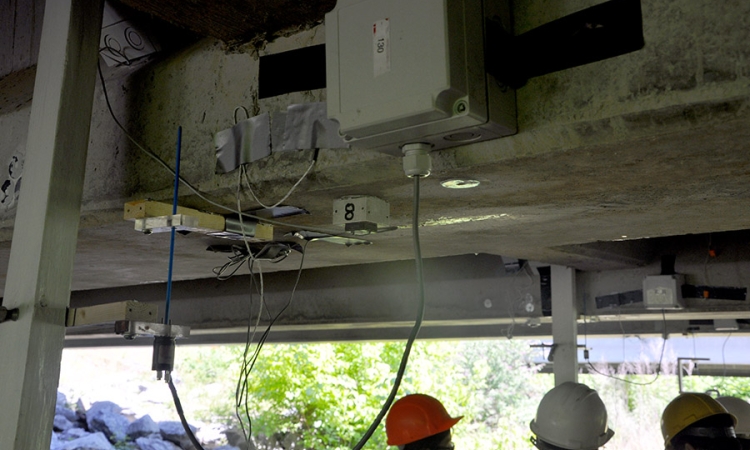
Dr. Wang’s research centers on advanced smart structural technologies designed to monitor and safeguard civil infrastructure systems, including buildings, bridges, tunnels, and dams. His group investigates cutting-edge sensing, control, and information technologies to enable the development of next-generation large-scale smart structural systems.
Education
| Ph.D. in Civil and Environmental Engineering | Stanford University | 2007 |
| M.S. in Electrical Engineering | Stanford University | 2007 |
| M.S. in Civil Engineering | Tsinghua University | 2001 |
| B.E. in Civil Engineering | Tsinghua University | 1998 |
Teaching
Dr. Wang teaches a broad range of undergraduate and graduate courses in structural engineering, covering topics from static to dynamic analysis of structural behavior under various loading conditions.
Distinctions & Awards
| 2019 | Air Force Research Lab Summer Faculty Fellowship Program (SFFP) Award |
| 2017 | The Achenbach Medal |
| 2017 | Air Force Research Lab Summer Faculty Fellowship Program (SFFP) Award |
| 2014 | Winner of Best Student Hardware Paper Competition (as advisor and co-author) ASME 2014 Conference on Smart Materials, Adaptive Structures and Intelligent Systems (SMASIS), Newport, RI, USA. |
| 2013 | AFOSR (Air Force Office of Scientific Research) Young Investigator Award |
| 2012 | NSF (National Science Foundation) Early Faculty Career Development (CAREER) Award |
| 2012 | IEEE-IMS (Instrumentation and Measurement Society) Faculty Course Development Award |
| 2012 | ASNT (American Society for Nondestructive Testing) Faculty Grant |
| 2011 | Best Student Paper Award (as advisor and co-author) The 8th International Workshop on Structural Health Monitoring, Stanford, CA, USA. |
| 2011 | Most Practical SHM Solution for Civil Infrastructures Award in the SHM-in-Action plenary competition The 8th International Workshop on Structural Health Monitoring, Stanford, CA, USA. |
Publications
- Otsuki, Y., and Wang, Y. (2025). “Recursive and batch Bayesian estimation of exponential non-viscous damping systems“, Mechanical Systems and Signal Processing, 222: 111703.
- Otsuki, Y., and Wang, Y. (2024). “Finite element model updating of non-proportional and exponential non-viscous damping systems using complex eigenvalues and eigenvectors“, Journal of Sound and Vibration, 589: 118589.
- Otsuki, Y., Nguyen, S. T., La, H. M., and Wang, Y. (2023). “Autonomous ultrasonic thickness measurement of steel bridge members using a climbing bicycle robot“, ASCE Journal of Engineering Mechanics, 149(8): 04023051.
- Li, D., and Wang, Y. (2022). “Constrained unscented Kalman filter for parameter identification of structural systems“, Structural Control and Health Monitoring, 29(4): e2908.
- Otsuki, Y., Lander, P., Dong, X., and Wang, Y. (2022). “Formulation and application of SMU – an open-source MATLAB package for structural model updating“, Advances in Structural Engineering, 25(4): 698-715.
- Otsuki, Y., Li, D., Dey, S.S., Kurata, M., and Wang, Y. (2021). “Finite element model updating of an 18-story structure using branch-and-bound algorithm with epsilon-constraint“, Journal of Civil Structural Health Monitoring, 11(3), 575-592.
- Wang, Z., and Wang, Y. (2021). “Bridge weigh-in-motion through bidirectional Recurrent Neural Network with long short-term memory and attention mechanism“, Smart Structures and Systems, 27(2): 241-256.
- Wu, D., Zeng, M., Zhao, H., Wang, Y., and Du, Y. (2021). “Detection and localization of debonding beneath concrete pavement using transmissibility function analysis“, Mechanical Systems and Signal Processing, 159: 107802.
- Liu, X., Wang, Y., and Verriest, E. (2021). “Simultaneous input-state estimation with direct feedthrough based on a unifying MMSE framework with experimental validation,” Mechanical Systems and Signal Processing, 147: 107083.
- Li, D., and Wang, Y. (2021). “Parameter identification of a differentiable Bouc-Wen model using constrained extended Kalman filter,” Structural Health Monitoring, 20(1): 360-378.
In the News
Schreiber Named SMART Scholar
Brown and Tien earn tenure, four others promoted to full professor