
Two teams of student innovators won $5,000 prizes with concepts for keeping vaccines cool during transportation and dust control on construction sites at the sixth annual Entrepreneurial Impact Competition on April 1.
The winning teams were among four finalists who pitched their ideas in front of a panel of judges and an audience at the event.
The finalists were selected from a field of 17 applicants. At the competition, each team had five minutes to explain their concept in front of an audience and then field 10 minutes of in-depth questioning from the panel of judges. After the presentations, the judges deliberated and selected the winner of the two awards.
The Higginbotham Entrepreneurship Award recognizes a more developed project, which is closer to being launched in the marketplace. The Zeitlin Innovation Award recognizes creativity in a project at any stage of its development.
Hydroloop, the team comprised of Anuj Patel and Robert Hauf, won the Higginbotham Entrepreneurial Award for their system to eliminate water waste and reduce dust-control costs on construction sites.
According to Hauf, the main problem with the current dust suppression method is “it’s largely brute force.”
Millions of gallons of potable water and thousands of dollars of excess fuel and labor are wasted and the result is a lack of management of the moisture levels in soil, he told the audience.
2026 Entrepreneurial Impact Competition
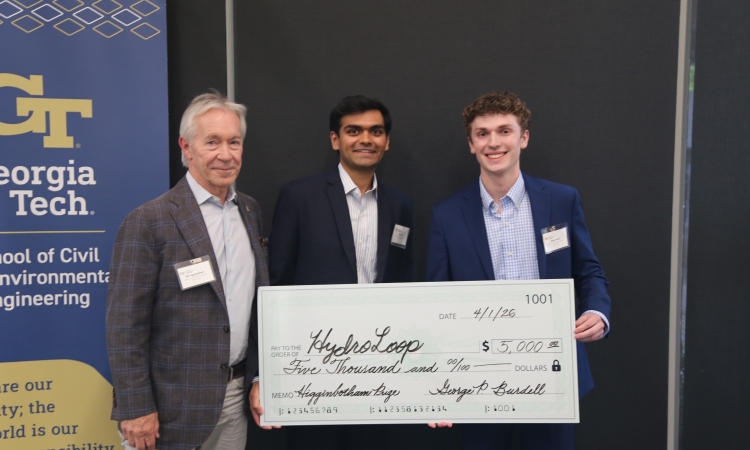
Bill Higginbotham, CE 76, presents the check for winning the Higginbotham Entrepreneurship Award to Anuj Patel, center, and Robbie Hauf of the winning team HydroLoop. (Photo by Michael Hunter)
“It’s inefficient and it relies on manual intervention to adjust the nozzles,” he said.
Hydroloop’s solution is a system of thermal imaging cameras and an automated nozzle system that can be rented by the companies as they rent the water trucks to control dust on the construction sites.
Team captain Anuj Patel explained the team’s business model, addressing a $204 billion site excavation and preparation market.
“When developing Hydroloop, the customer return on investment and impact was a high priority of ours,” Patel said.
He predicted a company could save 25% on water and 15% in fuel and labor, creating a 167% return on investment when integrating Hydroloop into their dust control. Additionally, the usage would save about 20,000 pounds of carbon emissions, creating a benefit for the local community in terms of air quality and the environment.
“When looking at the financial perspective, Hydroloop hopes to break even in year 2.5,” he said.
He explained that the planned $500 a month rental would allow customers to try the technology out at a low cost while allowing Hydroloop to be the asset owners, allowing for a recurring revenue model as well as asset depreciation over time.
“Our goal at Hydroloop is not only to maximize the efficiency of dust control on sites, but to work towards a future where we can implement our models in other aspects such as landscaping or reusing concrete washout water,” he concluded.
OmniTherm, the team of Veda Kodithala, Eden Goode, Amaniel Tesfay, Bin Huang, Adrian Trujillo and Roshni Chimmili, won the 2025 Zeitlin Innovation Award.
Team member Adrian Trujillo began the presentation by asking how many audience members had ever received a vaccine.
“We all understand how vital vaccines are, but up to 50% of vaccines produced globally are wasted every year, with a large portion of this waste happening during the last stage of transportation from district stores to local clinics to patients,” he said.
OmniTherm is a fully passive, reusable vaccine carrier that is engineered to keep vaccines safe without relying on a fragile power grid.
Current vaccine carriers can only last 40-45 hours and have a capacity of just 3.4 liters, while the OmniTherm carrier will last from 53-61 hours and provides 5 liters of usable space, said team captain Bin Huang. Additionally, the OmniTherm carrier includes backpack style straps for ease of transportation and vacuum insulation panels that are lighter and better than traditional insulation.
The OmniTherm carrier relies on an innovative combination of phase change material (PCM), which absorbs heat through melting and releases heat through freezing, maintaining a constant temperature, and a graphite-coated gyroidal skeleton, which extends the PCM cooling time by 5-6 hours while decreasing the freezer conditioning time from 4.9 to 3.9 hours.

The 2026 EIC judges panel (l to r): Scott Johnson, CE 94, Garland Long, CE 90, Jack Walz, BSCE 82, Kelley Brown, CE 91, and Elliot Siegel, MSCE 96. (Photo by Michael Hunter)
“At $400 per unit, OmniTherm is accessible to NGOs and government procurement programs,” said team member Veda Kodithala. “And at $86 per cost-of-good sold, we have strong margins that allow us flexibility of scale.
“If adopted by UNICEF alone, we estimate we not only save $50 million annually, but the lives of 330,000 children every single year,” she said.
FEArless, the team of Aarosh Dahal and Summit Shrestha, were the finalists for the Higginbotham award with their project FEA.I. FEA.I utilizes AI technology to make Finite Element Analysis (FEA) simpler and more affordable.

OmniTherm, (l to r) Amaniel Tesfay, Eden Goode, Roshni Chimmili, Adrian Trujillo, Veda Kodithala and Bin Huang, receive the Zeitlin award check from School Chair Don Webster.
DozeOn Technologies, the team of Alani Allen and Andrea Lewis, were the finalists for the Zeitlin award. Their construction site safety project featured a unified system of fixed cameras, LiDAR, and thermal imaging to provide heavy equipment operators with comprehensive, real-time environmental awareness and improved visibility.
The team of judges, comprised of notable CEE alumni who are business owners or experts in their field, were impressed by all the competitors.
“The judges were struck by the large number and high quality of the submissions this year,” said Associate Chair John E. Taylor, the host of this year’s Entrepreneurial Impact Competition. “It shows how the culture of entrepreneurship and innovation is spreading at CEE.”
The Entrepreneurial Impact Competition was established in 2021 to encourage a spirit of entrepreneurship in CEE students. The idea was led by Bill Higginbotham, CE 76, a serial entrepreneur and instructor who teaches Innovation and Entrepreneurship in CEE Systems. He endowed the Higginbotham Entrepreneurship Award and Greg Zeitlin established the Zetilin Innovation Award in honor of his parents, Phyllis C. And Alan G. Zeitlin, CE 62.