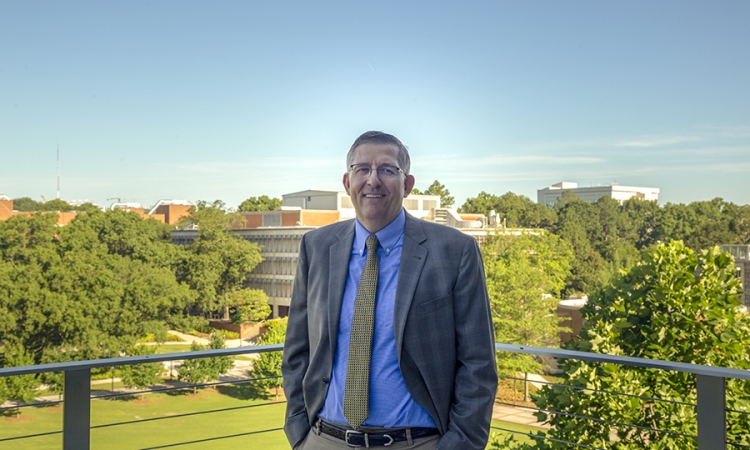
Karen and John Huff School Chair & Professor
Biography
Dr. Donald Webster received his Ph.D. in mechanical engineering from the University of California at Berkeley in 1994. After a postdoctoral research position at Stanford University and a non-tenure track faculty position at the University of Minnesota, he joined the faculty at Georgia Tech in September 1997. For nearly two decades, he has been part of the School's leadership team, serving as an affinity group coordinator 2012-2014, the associate chair for undergraduate programs 2007-2012, the associate chair for graduate programs 2012-2013, and the associate chair for finance and administration 2013-2018. In May 2018, he became the Karen and John Huff School Chair. Dr. Webster's research expertise lies in environmental fluid mechanics, with an emphasis on the influence of fluid mechanics and turbulence on biological systems. He has authored or co-authored over 110 refereed research articles. In recognition of these contributions, Dr. Webster is a Sustaining Fellow of the Association for the Sciences of Limnology and Oceanography (ASLO) and a Fellow of the American Society of Civil Engineers (ASCE). In 2016, his work on pteropod (i.e., the flying sea snail) biomechanics was featured in the New York Times among over 80 news agencies. Dr. Webster has been very active in professional service. He has served on the editorial board for the journal Experiments in Fluids since 2006 and has served on numerous conference and symposium advisory committees as well as other society committees. Dr. Webster developed several special topical sessions for the Ocean Science Meeting as well as the American Physical Society Division of Fluid Dynamics annual meeting, and used these forums to define the area of “Ecological Fluid Mechanics,” which broadly seeks to address the role that fluid motion, flow gradients, and chemical stirring play in shaping organism behavior, interactions, recruitment, reproduction, and community structure. Dr. Webster holds a professional engineering license (PE) in Georgia.
Research
Dr. Webster's research expertise lies in environmental fluid mechanics, with an emphasis on the influence of fluid mechanics and turbulence on biological systems. His contributions have been in three arenas: 1) illuminating the fluid mechanics processes related to sensory biology and biomechanics; 2) developing advanced experimental techniques and facilities; and 3) translating research results into bio-inspired design. Examples of innovative and creative contributions include turbulent chemical plume tracking by blue crabs, biologically-inspired design of a robotic tracker of turbulent chemical plumes, tomographic (3D) particle image velocimetry of zooplankton propulsion (krill, copepods, pteropods, daphnids), zooplankton aggregations around oceanic thin layer structure, and copepod-turbulence interactions.
Education
Ph.D. Mechanical Engineering University of California at Berkeley 1994
M.S. Mechanical Engineering University of California at Berkeley 1991
B.S. Mechanical Engineering University of California at Davis 1989
Teaching
Dr. Webster's educational activities include teaching courses in fluid mechanics, as well as rigid body dynamics. He is known for his efforts to develop effective blended (or flipped) classroom pedagogy for engineering mechanics courses. He has documented the effectiveness of the approach via a series of publications. Dr. Webster played a key role in developing the Bachelor of Science in Environmental Engineering program at Georgia Tech and served on the steering committee to develop Georgia Tech's interdisciplinary Ph.D. program in Ocean Science & Engineering. Further, he served as co-PI on an NSF-supported Integrative Graduate Education and Research Training (IGERT) grant to train students in the physics, chemistry, and ecology of chemical and hydrodynamic signaling in aquatic communities. Finally, he served as PI for an NSF-supported Revolutionizing Engineering Departments (RED) grant to lead a cultural shift and re-imagine the Civil Engineering and Environmental Engineering curriculum.
Distinctions & Awards
- Fellow, American Society of Civil Engineers, 2023
- Felton Jenkins, Jr. Hall of Fame Faculty Award, 2020 (University System of Georgia Excellence in Teaching Award)
- Fellow, ACC Academic Leaders Network, 2019
- Sustaining Fellow, 2018; Fellow, 2015, Association for the Sciences of Limnology and Oceanography (ASLO)
- Student Recognition of Excellence in Teaching: Class of 1934 CIOS Honor Roll, 2020
- Class of 1940 Course Survey Teaching Effectiveness Award, 2017, 2015
- Class of 1934 Outstanding Innovative Use of Education Technology Award, 2015
- Geoffrey G. Eichholz Faculty Teaching Excellence Award, 2014
- British Petroleum / CETL Junior Faculty Teaching Excellence Award, 2001
Publications
- Connor, A.A., M. Mohaghar, and D.R. Webster (2025) Hydrodynamics of active metachronal swimming modes in Antarctic krill, Euphausia superba. Marine Biology 172: 135 (20pp). https://doi.org/10.1007/s00227-025-04680-x
- Muscalus, A.C., K.A. Haas, and D.R. Webster (2025) Effects of primary ship waves in a far-field waterway network. ASCE Journal of Waterway, Port, Coastal, and Ocean Engineering. 151(4): 04025014 (19pp). https://doi.org/10.1061/JWPED5.WWENG-2199
- Ruszczyk, M., D.R. Webster, and J. Yen (2024) The response of a freshwater copepod to small-scale, dissipative eddies in turbulence. Limnology & Oceanography 69: S17–S31. https://doi.org/10.1002/lno.12402 Note: This paper appears in an invited special issue “Life in Turbulent Waters: Exploring Unsteady Biota-Flow Interactions Across Scales”.
- Mohaghar, M. and D.R. Webster (2024) Hydrodynamics of cruise swimming and turning maneuvers in Euchaeta antarctica. Scientific Reports 14: 28217 (15pp). https://doi.org/ 10.1038/s41598-024-76439-1
- Muscalus, A.C., K.A. Haas, and D.R. Webster (2024) Observations of primary ship waves at the margin of a confined tidal river. ASCE Journal of Waterway, Port, Coastal, and Ocean Engineering. 150(5): 04024009 (16pp). https://doi.org/10.1061/JWPED5.WWENG-2062
- Mohaghar, M., A. Connor, S. Wu, R. Zhao, and D.R. Webster (2024) Effects of symmetry-breaking mechanisms on the flow field around magnetic-responsive material appendages that mimic swimming strokes. Physical Review Fluids 9: 023101 (19pp). https://doi.org/10.1103/PhysRevFluids.9.023101
- Connor, A.A. and D.R. Webster (2023) Hydrodynamics of the fast-start caridoid escape response in Antarctic krill, Euphausia superba. Scientific Reports 13: 5376 (12pp). https://doi.org/10.1038/s41598-023-31676-8 Note: This paper appears in an invited collection “Biofluid Dynamics”.
- Mohaghar, M. and D.R. Webster (2023) Experimental investigation of non-linear standing internal waves using combined density and velocity measurements. Experiments in Fluids 64: 77 (17pp). https://doi.org/10.1007/s00348-023-03621-y
- Elmi, D., D.R. Webster, and D.M. Fields (2022) Copepod interaction with small-scale, dissipative eddies in turbulence: Comparison among three marine species. Limnology & Oceanography 67: 1820-1835. https://doi.org/10.1002/lno.12169
- Young, D.L., D.R. Webster, and A.I. Larsson (2022) Structure and mixing of a meandering turbulent chemical plume. Turbulent mixing and eddy-diffusivity. Experiments in Fluids 63:3 (11pp) https://doi.org/10.1007/s00348-021-03354-w
In the News
CEEatGT Awarded $1 Million Educational Grant
CEE Introduces Construction and Infrastructure Systems Engineering Concentration